JWT or Clerk? Choosing the Right Authentication for Your Next Project
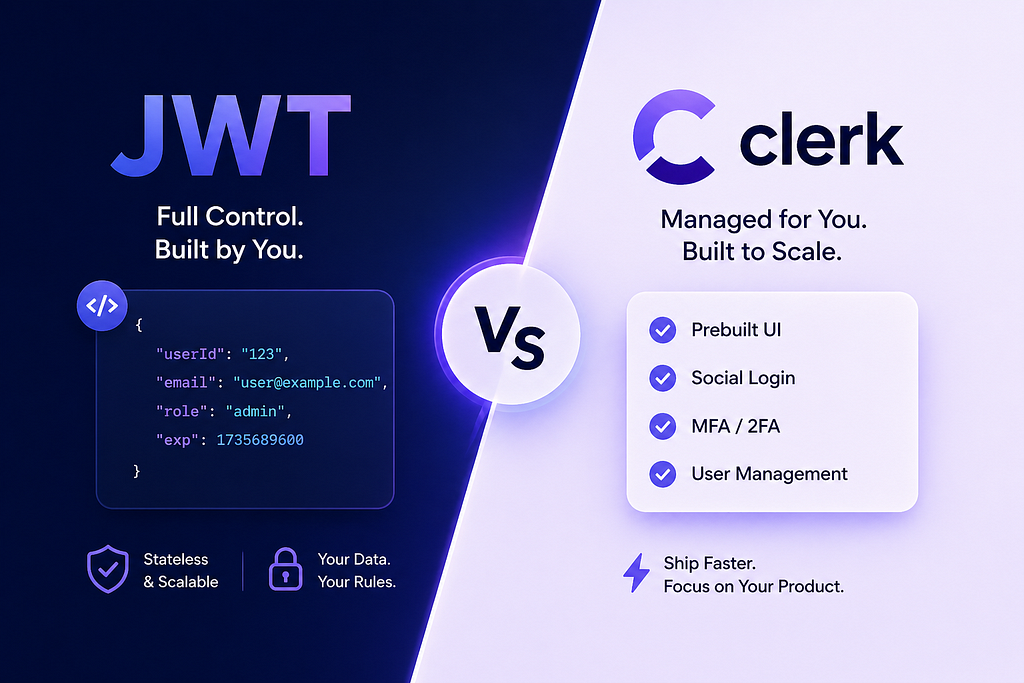
A practical breakdown of two popular auth approaches — when to roll your own tokens and when to let a service handle it all.
Authentication is one of those things that sounds simple until you actually build it. You start with a login form, then you need sessions, then token refresh, then OAuth with Google… and suddenly you’ve spent three days on auth instead of shipping features.
That’s exactly the decision most developers hit early in a project: do you implement JWT-based authentication yourself, or do you reach for a managed service like Clerk?
In this post, I’ll break down both approaches — what they are, how they work, the trade-offs, and which one to pick based on your project type.
What is JWT?
JWT stands for JSON Web Token. It’s an open standard (RFC 7519) for securely transmitting information between parties as a compact, self-contained token.
A JWT has three parts separated by dots:
header.payload.signature
eyJhbGciOiJIUzI1NiIsInR5cCI6IkpXVCJ9.
eyJ1c2VySWQiOiIxMjMiLCJlbWFpbCI6InVzZXJAZXhhbXBsZS5jb20ifQ.
SflKxwRJSMeKKF2QT4fwpMeJf36POk6yJV_adQssw5c- Header — algorithm and token type
- Payload — the actual user data (userId, email, role, etc.)
- Signature — verifies the token wasn’t tampered with
When a user logs in, your server creates a JWT signed with a secret key and sends it to the client. On every subsequent request, the client sends that token back. Your server verifies the signature — no database lookup needed.
A quick example with Node.js + Express
const jwt = require('jsonwebtoken');

// Generate token on login
const token = jwt.sign(
  { userId: user._id, email: user.email },
  process.env.JWT_SECRET,
  { expiresIn: '7d' }
);

// Verify token in middleware
const authMiddleware = (req, res, next) => {
  const token = req.headers.authorization?.split(' ')[1];
  try {
    const decoded = jwt.verify(token, process.env.JWT_SECRET);
    req.user = decoded;
    next();
  } catch (err) {
    res.status(401).json({ message: 'Unauthorized' });
  }
};
JWT is stateless — the token carries all the information. Your server doesn’t need to hit a database to validate every request. This is why it scales so well.
What is Clerk?
Clerk is a fully managed authentication and user management platform. Instead of building login flows, session handling, and token management yourself, you integrate Clerk’s SDK and it handles all of that for you — including the UI.
With Clerk you get out-of-the-box:
- Prebuilt sign-in / sign-up components
- Social login (Google, GitHub, Apple, etc.)
- Multi-factor authentication (MFA/2FA)
- Magic links and OTP via email/SMS
- User management dashboard
- Session management and token refresh
- Webhooks for user events
A quick example with Next.js + Clerk
// pages/api/protected.js
import { getAuth } from '@clerk/nextjs/server';

export default function handler(req, res) {
  const { userId } = getAuth(req);

  if (!userId) {
    return res.status(401).json({ error: 'Unauthorized' });
  }

  res.json({ message: `Hello user ${userId}` });
}
Worth noting: Clerk uses JWTs under the hood — but you never see them. The SDK handles token generation, storage, refresh, and validation automatically.
JWT vs Clerk — the key differences
Setup time JWT requires you to write the auth logic yourself — middleware, token generation, error handling, refresh tokens. Clerk can be integrated in under 10 minutes.
Social login With JWT, you have to set up each OAuth provider (Google, GitHub, etc.) manually — registering apps, handling callbacks, storing tokens. Clerk includes all of this out of the box.
Security JWT puts the responsibility on you. If you misconfigure token expiry, store tokens insecurely, or forget to handle edge cases, your app is vulnerable. Clerk handles security best practices for you.
Flexibility JWT gives you complete control. You can put anything in the payload, use any library, and integrate with any stack. Clerk is more opinionated and works best with React-based frameworks like Next.js.
Cost JWT is free — it’s just a standard. Clerk has a free tier (up to 10,000 monthly active users) but becomes paid at scale.
Vendor dependency With JWT, your auth lives entirely on your servers. With Clerk, you depend on their service being up and their pricing not changing.
When to use JWT
JWT is the right call when you want full control, have specific security requirements, or are working on a project where you can’t rely on external services.
Use JWT when:
- You’re building a REST or GraphQL API consumed by mobile or frontend clients
- You need custom token payloads — for example, including user roles, permissions, or organization IDs
- You’re working in a non-JavaScript stack like Python, Go, or Java where Clerk has no native SDK
- Your project has strict data residency requirements and no user data should leave your servers
- You’re building a microservices architecture where multiple services need to validate tokens independently
- You want to understand how authentication actually works under the hood
One thing to watch out for: If you go the JWT route, make sure you handle token expiry, refresh token rotation, and secure storage properly. These are where most DIY auth implementations go wrong.
When to use Clerk
Clerk shines when you want to move fast, need social login, and don’t want auth to be a distraction from building your actual product.
Use Clerk when:
- You’re building a Next.js, React, or Remix application
- You need Google, GitHub, or Apple login without the OAuth headache
- You’re building an MVP and need to ship quickly
- Your team doesn’t have deep security expertise to implement auth safely
- You want a user management dashboard without building one from scratch
- You need multi-factor authentication and don’t want to implement it yourself
Can you use both together?
Yes — and this is actually a common pattern. Clerk handles user authentication on the frontend and issues a JWT session token. You then use that JWT to authenticate requests to your own backend API, where you validate it using Clerk’s SDK.
// Your Express backend — verifying Clerk's JWT
import { ClerkExpressRequireAuth } from '@clerk/clerk-sdk-node';

app.get('/api/data', ClerkExpressRequireAuth(), (req, res) => {
  const { userId } = req.auth;
  res.json({ userId, data: 'protected data here' });
});
This gives you the best of both worlds: Clerk’s polished frontend auth experience, and full control over your backend API.
Quick decision guide
- API-only backend with mobile clients → JWT
- Next.js SaaS app needing Google login → Clerk
- Microservices that need stateless token validation → JWT
- MVP — need to ship in days, not weeks → Clerk
- Enterprise app with strict data compliance → JWT
- Side project with social auth and MFA → Clerk
- Learning how authentication works → JWT
- Team without deep auth security experience → Clerk
Final thoughts
There’s no universally better option here. JWT gives you control and zero vendor dependency at the cost of implementation complexity. Clerk gives you speed and polish at the cost of flexibility and pricing at scale.
My personal take: use Clerk for frontend-heavy apps and MVPs, and use JWT directly for backend APIs, microservices, and projects where data sovereignty matters. When in doubt, start with Clerk — you can always migrate to a custom solution once you understand your exact needs.
Either way, never roll your own cryptography. Stand on the shoulders of well-tested libraries.
~ Akil Dikshan ~